
Building formwork is a temporary mould that holds fresh concrete in place until it hardens. This guide explains the types, uses, and preparation of building formwork, helping building technicians understand how to select, prepare, and handle formwork safely and efficiently.
Introduction: What Is Building Formwork?
Building formwork refers to the temporary structure that shapes and supports concrete during casting. Moreover, it controls the concrete’s position, dimensions, and surface finish. Consequently, formwork plays a direct role in the quality and safety of every concrete element.
In addition, formwork is not a permanent part of the building. Therefore, workers remove it once the concrete gains sufficient strength. Nevertheless, its design and preparation demand careful attention, because mistakes lead to bulging, misalignment, or collapse.
Why Building Formwork Matters
Formwork affects cost, speed, and quality. In fact, formwork often accounts for 20 to 30 per cent of the total cost of a concrete structure. Furthermore, poor formwork causes honeycombing, dimensional errors, and surface defects.
In addition, formwork protects workers during casting. When formwork fails, wet concrete escapes with enormous force. Consequently, injuries and structural damage follow. Therefore, technicians must treat formwork as a structural system, not a simple box.
Functions of Building Formwork
Formwork performs several essential functions.
- it gives concrete its required shape and size.
- it supports the weight of fresh concrete, reinforcement, and workers.
- it resists the lateral pressure of wet concrete.
- it provides a surface that determines the final finish.
- it allows safe access for placing and compacting concrete.
Good formwork must meet several requirements. Therefore, technicians should check each one before use.
- Strength – it must resist dead loads, live loads, and concrete pressure without failure.
- Stability – it must not overturn or shift during casting.
- Rigidity – it must not deflect excessively, because deflection causes misalignment.
- Tightness – joints must not leak mortar, which causes honeycombing.
- Accuracy – it must produce the correct dimensions and level.
- Durability – it must withstand repeated handling and reuse.
- Economy – it must use materials efficiently.
- Workability – it must be easy to erect, strip, and move.
Types of Building Formwork
Formwork comes in several types, each suited to particular elements and project conditions. The main types are described below.
1. Timber Formwork
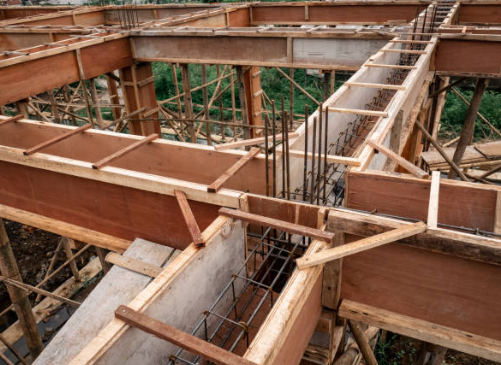
Timber formwork is the traditional and most flexible type. Workers fabricate it on site from boards, battens, and plywood. Moreover, timber adapts easily to irregular shapes, which makes it ideal for repair work and complex elements.
However, timber absorbs water, so it swells and warps with repeated use. Therefore, technicians apply a release agent and dry timber properly between uses. In addition, timber formwork suits small and medium projects where labour is readily available.
2. Plywood Formwork
Plywood formwork uses large plywood sheets fixed to timber or steel framing. Consequently, it produces a smoother finish with fewer joints. Furthermore, plywood resists water better than plain boards when it carries a resin-bonded coating.
As a result, plywood formwork has become the most common type for walls, slabs, and columns.
3. Steel Formwork
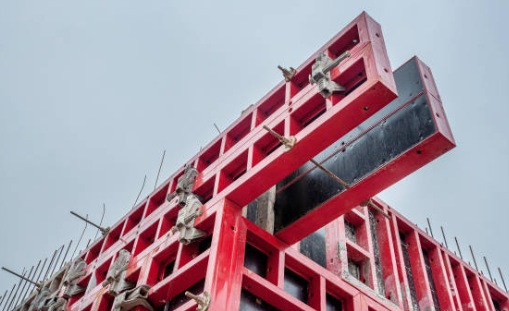
Steel formwork uses prefabricated steel panels. It offers high strength, excellent dimensional accuracy, and a long service life. Therefore, it suits large repetitive projects such as high-rise buildings and tunnels.
In addition, steel formwork produces a very smooth finish. However, it costs more initially and requires lifting equipment because of its weight.
4. Aluminium Formwork
Aluminium formwork is lightweight yet strong. Consequently, workers can handle it manually, which speeds up erection. Moreover, it resists corrosion and produces a good finish.
Therefore, aluminium formwork suits repetitive layouts in residential and commercial construction.
5. Plastic and Fibreglass Formwork
Plastic and fibreglass formwork serve specialised needs. For instance, they suit curved, textured, or complex shapes. Furthermore, they are lightweight and resist moisture.
However, they may deflect under heavy loads. Therefore, technicians use them mainly for architectural features and small elements.
6. Permanent Formwork
Permanent formwork remains in place after casting. For example, precast concrete planks and insulating blocks act as both formwork and part of the finished structure. Consequently, permanent formwork saves stripping time, though it offers limited reuse.
7. Slip Formwork
Slip formwork moves continuously upward as concrete sets. Therefore, it suits tall vertical elements such as silos, chimneys, and core walls. Moreover, it eliminates horizontal construction joints and speeds up construction.
8. Climbing Formwork
Climbing formwork rises with the structure in controlled lifts. Consequently, it suits high-rise cores and bridge piers. In addition, it combines strength with safe working platforms.
Uses of Building Formwork
Formwork serves every concrete element in a building. The table below summarises the main applications.
| Element | Typical Formwork Type |
| Foundation footings | Timber or plywood |
| Retaining walls | Plywood with timber or steel framing |
| Columns | Steel, aluminium, or plywood box |
| Beams and slabs | Plywood with props and bearers |
| Stairs | Timber, carefully fabricated |
| Suspended floors | Plywood deck with props and joists |
| Silos and chimneys | Slip formwork |
| High-rise cores | Climbing formwork |
| Architectural features | Plastic or fibreglass |
Materials Used in Building Formwork
Formwork materials must balance strength, weight, cost, and reuse. Therefore, technicians should understand the main options.
- Timber – versatile, cheap, easy to cut, but absorbs water.
- Plywood – strong, smooth, reusable, and water-resistant when coated.
- Steel – strong, accurate, durable, but heavy and costly.
- Aluminium – light, strong, corrosion-resistant, but softer than steel.
- Plastic and fibreglass – light, moisture-resistant, suitable for complex shapes.
- Formwork accessories – tie rods, clamps, props, wedges, and release agents.
Preparation of Building Formwork
Preparation determines whether formwork performs safely and produces good concrete. Therefore, follow these steps carefully.
Step 1: Study the Working Drawing
First, read the working drawing and identify the element to be cast. Note its dimensions, levels, and reinforcement details. Moreover, confirm the formwork type specified.
Step 2: Select and Inspect Materials
Next, select formwork materials that suit the element. Inspect each panel, board, and accessory for damage. Consequently, reject warped, split, or corroded items.
Step 3: Clean and Treat Surfaces
Clean all formwork surfaces before assembly. Remove old concrete, nails, and debris. Then, apply a release agent evenly. As a result, the formwork strips cleanly and the concrete surface stays smooth.
Step 4: Erect the Formwork Accurately
Assemble the formwork to the correct dimensions, level, and alignment. Use a tape measure, spirit level, and plumb bob to check accuracy. Furthermore, brace the formwork firmly so it cannot move during casting.
Step 5: Seal Joints and Fixings
Seal all joints to prevent mortar loss. Use tape, fillets, or tightly fitted joints. In addition, tighten clamps, tie rods, and wedges so the formwork resists concrete pressure.
Step 6: Check Plumbness, Squareness, and Support
Verify plumbness on vertical faces and squareness at corners. Moreover, check that props and shores bear firmly on solid ground. Consequently, the formwork remains stable throughout casting.
Step 7: Apply Release Agent Again if Needed
If assembly disturbs the coating, re-apply the release agent. Therefore, keep the coating continuous across the whole surface.
Step 8: Inspect Before Casting
Finally, carry out a full inspection before pouring concrete. Check dimensions, supports, joints, and cleanliness. As a result, you prevent bulging, leakage, and collapse.
Formwork Accessories
Accessories hold the formwork together and transfer loads. Therefore, technicians must know each item.
- Tie rods – resist lateral pressure in wall formwork.
- Clamps – connect panels and beams.
- Props (shores) – support slabs and beams from below.
- Joists and bearers – distribute loads to props.
- Wedges – tighten and adjust formwork.
- Release agents – prevent concrete from bonding to formwork.
- Spacers – maintain the correct concrete cover.
Stripping and Removal of Formwork
Stripping must wait until the concrete gains sufficient strength. Therefore, follow the specified curing periods.
- Vertical faces (walls, columns) – strip after 24 to 48 hours.
- Soffits of beams and slabs – strip after 7 to 14 days, depending on span and load.
- Props under long spans – leave longer, or re-prop as designed.
During stripping, work from the top downward and release supports gradually. Moreover, avoid shock loads, because they damage the concrete surface.
After removal, clean the formwork, replace damaged parts, and store it under cover. Consequently, the formwork remains ready for the next cycle.
Common Mistakes in Building Formwork
Many formwork failures arise from avoidable errors. Therefore, avoid the following common mistakes.
- Using warped or damaged panels.
- Failing to apply a release agent.
- Leaving gaps that leak mortar.
- Under-designing props and braces.
- Bearing props on soft or sloping ground.
- Stripping formwork too early.
- Overloading the formwork during casting.
- Neglecting inspection before the pour.
Conclusion
Building formwork shapes every concrete element in a structure. When technicians select the right type, prepare it carefully, and strip it at the right time, they achieve accurate dimensions, good finishes, and safe construction.
Moreover, formwork preparation is not a single task. Instead, it is a sequence of checks covering materials, assembly, support, and inspection. Therefore, treat each step as essential. As a result, formwork works reliably, costs stay controlled, and concrete quality meets specification.
Frequently Asked Questions
What is building formwork?
Building formwork is a temporary mould that holds fresh concrete in place until it hardens. It shapes the concrete and supports it during curing.
What are the main types of building formwork?
The main types are timber, plywood, steel, aluminium, plastic, fibreglass, permanent, slip, and climbing formwork. Each suits different elements and project conditions.
Why is a release agent applied to formwork?
A release agent prevents fresh concrete from bonding to the formwork surface. Consequently, the formwork strips cleanly and the concrete finish stays smooth.
When should formwork be stripped?
Strip vertical faces after 24 to 48 hours. Strip beam and slab soffits after 7 to 14 days, depending on span and loading. Always follow the specification.
How should formwork be stored?
Clean formwork after stripping, replace damaged parts, and store it under cover on bearers. Consequently, it stays dry and ready for reuse.