
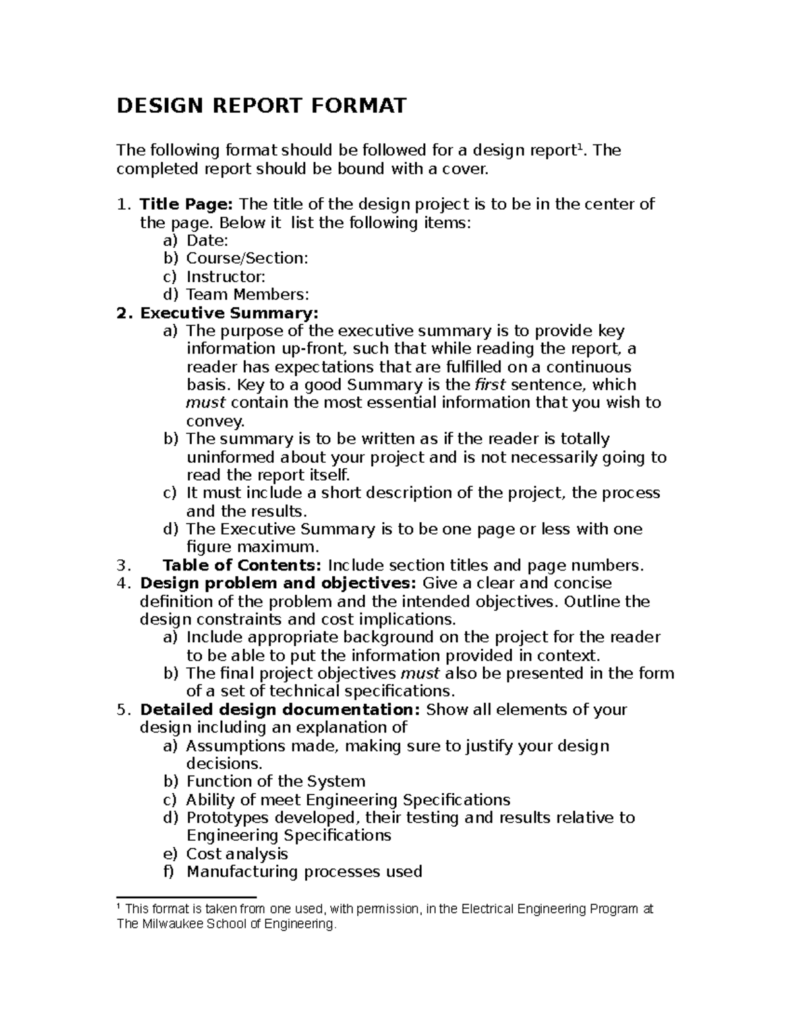
In the field of environmental engineering, preparing a design report is not a creative exercise it is a structured process governed by established formats that ensure consistency, completeness, and regulatory compliance. A design report is a comprehensive description of a water quality problem and the proposed solution, including applicable design criteria and data supporting the solution . The report must evaluate potential solutions and clearly demonstrate that acceptable engineering principles were used in the evaluation, that the data supports the conclusions, and that the proposed solution has reasonable expectations of solving the water quality problem .
This guide explains how to prepare a design report based on identified formats, drawing from the official Engineering Report Outline for New York State Wastewater Infrastructure Projects and other regulatory standards.
Understanding the Purpose of a Design Report
Before preparing a report, engineers must understand what it is meant to accomplish. The primary functions of an engineering report are to:
- Define the need for the project
- Identify how the project is expected to protect or improve water quality
- Evaluate alternative ways to solve the water quality problem
- Recommend a technically and financially sound alternative
The selection of a recommended alternative is supported with preliminary design considerations, including technical standards and data demonstrating the alternative can reasonably solve the problem, life cycle cost estimates, and a schedule identifying steps from submission through construction completion .
Engineering Report Preparation Standards
A design report must be prepared, stamped, and signed by a qualified professional licensed to practice in the relevant jurisdiction and developed in accordance with the latest editions of applicable standards . These typically include:
- Recommended Standards for Wastewater Facilities (Ten States Standards)
- Recommended Standards for Water Works
- TR-16 Guides for the Design of Wastewater Treatment Works
- State-specific stormwater management design manuals
- State-specific design standards for wastewater treatment systems
- Flood risk management guidance
In instances where the design engineer proposes a deviation from these standards, the report must clearly explain and justify the deviation . In all cases, facilities must be designed to treat permitted flows and loads.
Minimum Requirements for Funding and Approval
For projects seeking funding, the engineering report must include eight essential elements :
| Requirement | Description |
| Currency | Prepared or updated within the specified timeframe |
| Final Version | Not a draft |
| Stamp and Signature | Signed by a qualified professional licensed in the jurisdiction |
| Problem Identification | Clearly define the issue and state a capital improvement project as the recommended solution |
| Alternatives Analysis | Evaluate multiple feasible solutions |
| Cost Estimate | Provide total project cost |
| Location Maps | Include or attach project location maps |
| Certification | Attach the completed engineering report certification |
Reports that do not include all these items may not receive funding .
The Core Sections: Preparing the Report Based on Identified Format
Each engineering report should contain a Table of Contents, including page numbers. The following sections set forth the basic structure of information necessary for development of a compliant design report .
1. Cover
The cover must contain :
- A descriptive project title
- Name of the Owner/Municipality
- Applicable discharge permit number
- Name of the engineering firm preparing the report
- Date of the report, including revision dates
- Professional Engineer stamp and signature
2. Executive Summary
Provide a brief description of the purpose of the report, need for the project, evaluations conducted, recommended alternative, schedule, cost, and next steps . This section serves as the high-level overview for decision-makers and funding agencies.
3. Definition of the Problem
Succinctly define the water quality issue to be addressed by the project. Consider the applicability of :
- Compliance with or violation of discharge permits
- Health, sanitation, security, and/or cybersecurity concerns
- Assets needing replacement
- Aging or inadequate infrastructure
- Need for redundancy
- Infiltration and inflow, combined sewer overflows, sanitary sewer overflows
- Groundwater/surface water contamination
- Reasonable growth and its impact on design flow rates
- Physical risk due to climate change
- Compliance with current standards
4. Project Background and History
4.1 Site Information
Describe the area(s) under consideration and include :
- Location
- Geologic conditions (soil type, depth to bedrock and groundwater, slope)
- Environmental resources (waterbodies, aquifers, endangered species, wetlands)
- Floodplain considerations including Base Flood Elevation
- Project impacts to Environmental Justice Areas and/or Disadvantaged Communities
4.2 Ownership and Service Area
Describe ownership of the facilities and area(s) being served or to be served :
- Municipality(ies) that own and maintain the infrastructure
- Areas served or to be served
- Outside users requiring inter-municipal/private/industrial agreements
- Industrial discharges or hauled waste
- Population trends and growth (U.S. Census data for at least the past twenty years)
- Residential population served, documented or estimated from Equivalent Dwelling Units (EDUs)
4.3 Existing Facilities and Present Condition
Provide overview of major system components including :
- General description and history with process flow diagram
- Current or future projects on the same site
- Discharge permit conditions and effluent discharge limits
- Documented compliance issues
- Design flows and waste loads (average and peak)
- Existing flows and waste loads from the last three years
- Existing energy consumption
- Photographs
- History of damage due to storm or flood impacts
5. Alternatives Analysis
A key requirement is the systematic comparison of feasible solutions. The engineer must analyze multiple alternatives different treatment processes, pipe routes, or sites .
The alternatives evaluation must include :
- Schematic diagrams of each alternative
- Preliminary design for cost estimates
- Total project costs dated and keyed to construction cost indices
- Advantages and disadvantages of each alternative
- Process effluent characteristics for each alternative
- Comparison of process performance
- Environmental assessment
- Operation and maintenance expenses with energy requirements
Non-monetary evaluation criteria should include :
- Operability: Ease of operation and maintenance
- Reliability: Proven process/technology to meet permit limits
- Flexibility: Capability to handle variations in hydraulic and waste loads
- Environmental Effects: Odor, noise, visual impacts, footprint
- Expandability: Area available for future expansion
6. Summary and Comparison of Alternatives
This section presents a clear comparison of all evaluated alternatives, typically using a matrix format that allows decision-makers to understand the relative merits and drawbacks of each option .
7. Recommended Alternative
With the problem defined and alternatives evaluated, the report moves to presenting the recommended solution . This section contains:
- A fully developed description of the proposed project
- Basis of design
- Facility layout plan and flow schematic
- Detailed description of treatment process
- Pumping station specifications
- Collection system layout
- Hydraulic calculations
- Implementation schedule
8. Cost Estimate and Annual Operating Budget
The report must include :
- Construction cost estimate by contract
- Total project cost including development, construction, land and rights, legal, engineering, interest, equipment, contingencies
- Annual Operation and Maintenance costs
- Present Worth analysis based on the applicable discount rate
9. Maps and Figures
All relevant maps, figures, and diagrams should be included or attached :
- Location maps showing the project site on a regional map
- Service area maps
- Proposed facility layout plans
- Process flow diagrams
- Hydraulic profiles
Appendices: Supporting Documentation
Appendix A: Energy Efficiency Best Practices
The report must address energy conservation measures and document how the design incorporates energy efficiency best practices . Typical energy efficiency measures include:
| Operation/Process | Baseline Practice | Energy Efficiency Practice |
| Influent Pumping | On/Off Level Control, Standard Motors | VFD with Control Loop, Premium Motors, Multiple Pumps |
| Aeration Blowers | Multi-Stage Centrifugal Blowers | Premium Motors, Inlet Flow Control, Single-Stage with VFD |
| DO Control | Manual handheld DO Monitoring | VFDs with DO or Pressure Control Loop |
| UV Disinfection | Medium Pressure UV Lamps | Low Pressure High Output with Dimming Capability |
Payback Period Calculation: The payback period should be calculated for energy efficient practices and compared to the expected useful life of the equipment .
Appendix B: Short-Lived Assets
The report must identify equipment and assets expected to require replacement before the end of the loan period . Time frames are established in three periods: 0-5 years, 5-10 years, and 10-15 years.
Appendix C: Engineering Report Certification
The Professional Engineer preparing the report must certify that they have studied and evaluated the cost and effectiveness of the processes, materials, techniques, and technologies for carrying out the proposed project .
Special Considerations for Specific Project Types
Collection Systems
For collection system projects, the report must address :
- Description of service area
- Inventory and map of proposed additions and rehabilitation
- Initial and projected loadings
- Isolation from water supply wells and reservoirs
- Unusual construction problems
- Basement flooding prevention during power outages
Pump Stations
For pump station projects, critical details include :
- Wet well sizing
- Pump selection with system and characteristic curves
- Pumping cycle determination
- Power failure provisions
- Emergency bypass provisions
Industrial Wastewater Facilities
For industrial wastewater facilities, the report must include :
- Type of industry and kind and quantity of finished product
- Quantity and quality of all process wastewater
- Amount and kind of chemicals used in treatment
- Basic design data and sizing calculations
- Discussion of site suitability
- Description of treatment process with flow diagram
- Provisions for bypass and spill control
- Detailed outfall analysis
- Statement that effluent will meet applicable permit limitations
Best Practices for Report Preparation
Currency and Timeliness
Engineering reports must be current. Reports more than four years old are likely to require revisions . Previously submitted reports may need to be rewritten to be consistent with current outlines.
Coordination with Stakeholders
During the entire study period, the team shall work in close coordination with local authorities and stakeholders. The report should document :
- Understanding of project features by service providers
- Commitment by local authorities to participate and contribute
- Commitment to provide required land for project facilities
- General attitude of users toward implementation
Review Process
Allocate sufficient time for review, comment, comment resolution, and approval . The review process involves multiple agencies and stakeholders.
Conclusion: A Framework for Success
Preparing a design report based on an identified format is not bureaucratic red tape it represents a proven framework for ensuring critical water infrastructure projects are designed with clarity, accountability, and long-term sustainability. The engineering report must present the technical and nontechnical issues that are most commonly addressed in the planning and design reports for wastewater treatment facilities prepared by practicing engineers .
By following this structured approach from defining the problem to detailing cost and operation engineers provide a clear, defensible, and comprehensive plan that protects public health and the environment for generations. Whether you’re a consulting engineer preparing your first design report or a reviewer evaluating submitted documentation, understanding and following the identified format is essential for successful project delivery and regulatory approval.
Related Resources