
Element 1.3 – Prepare a realistic construction schedule based on project specifications for onsite sanitation facilities
INTRODUCTION
To prepare project management timelines sanitation facilities is the third critical skill after reading drawings and identifying activities. You have interpreted the engineering drawings. You have identified all construction activities from the scope of work. Now comes the next question: How long will each activity take, and in what order must they happen?
A construction schedule is not a guess. It is a calculated plan that shows every activity, its duration, its dependencies, and the people and equipment needed. Without a schedule, projects run late, costs overrun, and clients lose confidence.
This blog post covers Element 1.3 of onsite sanitation training. You will learn how to prepare project management timelines sanitation using Work Breakdown Structure (WBS), Gantt charts, Critical Path Method (CPM), milestone schedules, and resource allocation.
By the end, you will be able to create a realistic construction schedule for any onsite sanitation facility , septic tank, bio-digester, ABR, pit latrine, soak pit, or Imhoff tank.
Before scheduling, you must first learn to identify construction activities onsite sanitation.
PART ONE: WHY YOU MUST PREPARE PROJECT MANAGEMENT TIMELINES SANITATION
Many contractors skip scheduling. They rely on memory or verbal promises. This approach fails for several reasons.
First, without a schedule, you cannot track progress. You do not know if you are ahead or behind until it is too late.
Second, without a schedule, you cannot coordinate subcontractors. The concrete team arrives before the excavation is complete. The pipe layers wait for days because the trench is not ready.
Third, without a schedule, clients lose trust. They ask, “When will you finish?” and you cannot give an answer.
Therefore, learning to prepare project management timelines sanitation is essential for professional contractors.
For project management standards, refer to PMI’s Project Management Body of Knowledge (external link).
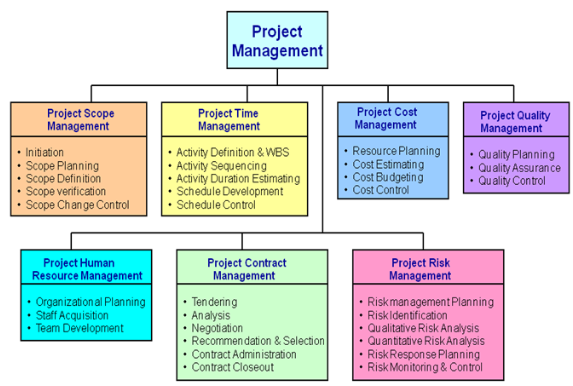
PART TWO: WORK BREAKDOWN STRUCTURE (WBS)
Before you can prepare project management timelines sanitation, you must break the project into smaller pieces. This is called a Work Breakdown Structure (WBS).
2.1 What is a WBS?
A WBS is a hierarchical breakdown of all work required to complete the project. It starts with the final deliverable at the top and splits into smaller and smaller tasks.
2.2 WBS Example for a Septic Tank Project
| Level | WBS Code | Activity Description |
| 1 | 1.0 | Construct Septic Tank System |
| 2 | 1.1 | Site preparation |
| 3 | 1.1.1 | Surveying and setting out |
| 3 | 1.1.2 | Clearing and grubbing |
| 2 | 1.2 | Earthworks |
| 3 | 1.2.1 | Excavation of tank pit |
| 3 | 1.2.2 | Excavation of pipe trenches |
| 3 | 1.2.3 | Timbering to trenches |
| 2 | 1.3 | Concrete works |
| 3 | 1.3.1 | Base slab reinforcement and pour |
| 3 | 1.3.2 | Wall reinforcement and pour |
| 3 | 1.3.3 | Cover slab reinforcement and pour |
| 2 | 1.4 | Pipe works |
| 3 | 1.4.1 | Pipe laying and jointing |
| 3 | 1.4.2 | Backfilling and compaction |
| 2 | 1.5 | Finishing |
| 3 | 1.5.1 | Plastering and apron |
| 3 | 1.5.2 | Cleaning and handover |
2.3 Why WBS Helps You Prepare Project Management Timelines Sanitation
The WBS ensures you do not miss any activity. Each small task becomes a line item in your schedule. Therefore, start every schedule with a complete WBS.
PART THREE: GANTT CHART
Once you have a WBS, the next step to prepare project management timelines sanitation is creating a Gantt chart.
3.1 What is a Gantt Chart?
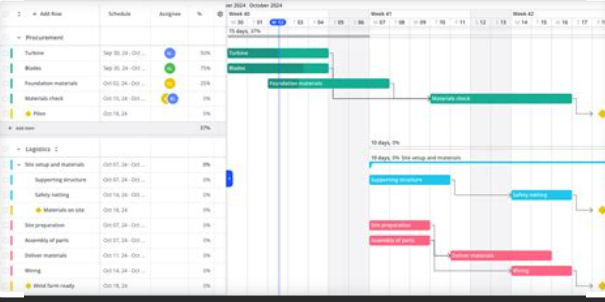
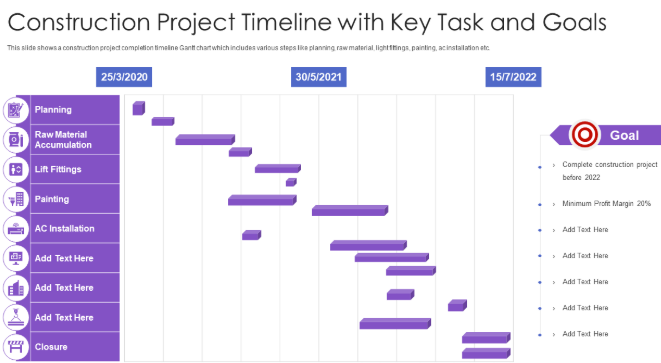
A Gantt chart is a bar chart that shows activities along a calendar. Each activity has a start date, an end date, and a duration. The chart also shows which activities depend on others.
3.2 How to Build a Gantt Chart
Follow these steps when you prepare project management timelines sanitation:
Step 1: List all WBS activities in the first column.
Step 2: Estimate the duration of each activity in days.
Step 3: Identify dependencies. For example, you cannot pour concrete before you install reinforcement.
Step 4: Assign start and end dates based on dependencies.
Step 5: Draw bars representing each activity across the calendar.
3.3 Example Gantt Chart for a Septic Tank (10-day schedule)
| Activity | Duration | Day 1 | Day 2 | Day 3 | Day 4 | Day 5 | Day 6 | Day 7 | Day 8 | Day 9 | Day 10 |
| Survey & set out | 1 day | X | |||||||||
| Excavation | 2 days | X | X | ||||||||
| Timbering | 1 day | X | |||||||||
| Base slab rebar | 1 day | X | |||||||||
| Base slab pour | 1 day | X | |||||||||
| Curing | 3 days | X | X | X | |||||||
| Wall rebar & pour | 1 day | X | |||||||||
| Pipe laying | 1 day | X | |||||||||
| Backfilling | 1 day | X | |||||||||
| Cover slab | 1 day | X | |||||||||
| Finishes | 1 day | X |
3.4 Estimating Activity Durations
When you prepare project management timelines sanitation, use realistic durations:
| Activity | Typical Duration |
| Surveying and setting out | 0.5 – 1 day |
| Excavation (tank pit) | 1 – 3 days |
| Timbering to trenches | 0.5 – 1 day |
| Reinforcement placement | 0.5 – 1 day |
| Concrete pour (base slab) | 0.5 – 1 day |
| Concrete curing | 3 – 7 days |
| Wall construction | 1 – 2 days |
| Pipe laying | 0.5 – 1 day |
| Backfilling | 0.5 – 1 day |
| Cover slab | 0.5 – 1 day |
| Finishes | 1 – 2 days |
Pro tip; Always add 10–20% contingency to durations. Unexpected delays happen — rain, material shortages, equipment breakdowns.
PART FOUR: CRITICAL PATH METHOD (CPM)
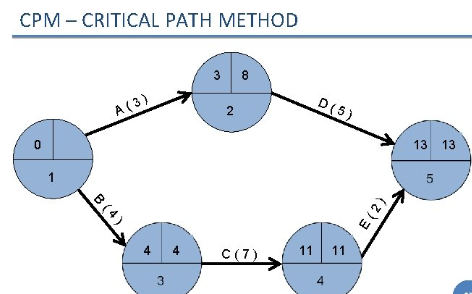
The Critical Path Method helps you prepare project management timelines sanitation by identifying the longest sequence of dependent activities.
4.1 What is the Critical Path?
The critical path is the longest path through the project network. Activities on this path have zero slack — any delay in these activities delays the entire project.
4.2 How to Find the Critical Path
Follow these steps when you prepare project management timelines sanitation:
Step 1: List all activities with their durations and dependencies.
Step 2: Draw a network diagram showing which activities must come before others.
Step 3: Calculate the earliest start and earliest finish for each activity.
Step 4: Calculate the latest start and latest finish for each activity.
Step 5: Identify activities where earliest start equals latest start — these are on the critical path.
4.3 Critical Path Example for a Septic Tank
| Activity | Duration (days) | Depends On | Critical? |
| A: Survey & set out | 1 | – | Yes |
| B: Excavation | 2 | A | Yes |
| C: Timbering | 1 | B | No |
| D: Base slab rebar | 1 | B | Yes |
| E: Base slab pour | 1 | D | Yes |
| F: Curing | 3 | E | Yes |
| G: Wall rebar & pour | 1 | F | Yes |
| H: Pipe laying | 1 | G | No |
| I: Backfilling | 1 | H | No |
| J: Cover slab | 1 | G | Yes |
| K: Finishes | 1 | J | Yes |
Critical Path: A → B → D → E → F → G → J → K (Total: 1+2+1+1+3+1+1+1 = 11 days)
Activities C, H, and I have slack. They can be delayed without affecting the project end date.
4.4 Why CPM Matters
When you prepare project management timelines sanitation, CPM tells you where to focus your attention. If you are behind on a critical path activity, you must take action immediately. If you are behind on a non-critical activity, you may have time to catch up.
For detailed CPM calculation methods, refer to Project Management Institute guidelines
PART FIVE: MILESTONE SCHEDULE
Milestones are key events in your project. They have zero duration. They mark important achievements.
5.1 Common Milestones for Onsite Sanitation
When you prepare project management timelines sanitation, include these milestones:
| Milestone | Description | Typical Day |
| Site possession | Contractor receives access to site | Day 0 |
| Survey complete | Setting out finished and approved | Day 1 |
| Excavation complete | Tank pit and trenches dug | Day 3 |
| Base slab complete | Concrete poured and curing started | Day 5 |
| Tank complete | Walls and cover slab finished | Day 9 |
| Pipe network complete | All pipes laid, jointed, and backfilled | Day 10 |
| Commissioning | Facility tested and working | Day 11 |
| Handover | Client accepts facility | Day 12 |
5.2 Why Milestones Help You Prepare Project Management Timelines Sanitation
Milestones give you checkpoints. After each milestone, you ask: “Are we on track?” If not, you adjust.
Milestones also help with client communication. Instead of saying “We are working on it,” you say “We completed excavation today. Next milestone is base slab by Friday.”
PART SIX: RESOURCE ALLOCATION
A schedule is useless if you do not assign resources. Resources include labour, equipment, materials, and money.
6.1 How to Allocate Resources
When you prepare project management timelines sanitation, follow these steps:
Step 1: For each activity, list the resources needed.
Step 2: Check if any resource is over-allocated (needed in two places at once).
Step 3: Level the resources by shifting non-critical activities.
6.2 Resource Allocation Example
| Activity | Labour | Equipment | Materials |
| Excavation | 2 labourers | Excavator, dump truck | None |
| Base slab rebar | 1 steel fixer | Rebar bender, cutter | Y12 bars, wire |
| Base slab pour | 3 labourers | Concrete mixer, vibrator | Class 25 concrete |
| Pipe laying | 2 pipe layers | Pipe cutter, level | 100mm uPVC pipes, solvent |
| Backfilling | 2 labourers | Plate compactor | Sand, selected soil |
6.3 Common Resource Mistakes
First mistake: Assuming unlimited labour. You cannot have the same steel fixer on two different slabs at the same time.
Second mistake: Forgetting equipment lead time. The excavator must be booked days in advance.
Third mistake: Ignoring material delivery schedules. Concrete must arrive when the team is ready to pour.
✅ Internal link: After scheduling, learn to prepare method statements for each activity.
PART SEVEN: LEARNING OUTCOME CHECK
After learning to prepare project management timelines sanitation, you should be able to:
| # | Learning Outcome |
| I | Create a Work Breakdown Structure (WBS) for any onsite sanitation facility |
| II | Build a Gantt chart with activity durations, start/end dates, and dependencies |
| III | Identify the critical path using CPM |
| IV | Define milestone schedule with key project events |
| V | Allocate labour, equipment, and materials to each activity |
| VI | Detect and resolve resource over-allocation |
| VII | Present a realistic schedule to clients and teams |
CONCLUSION
Learning to prepare project management timelines sanitation transforms you from a worker into a manager.
The worker starts digging and hopes for the best.
The manager creates a WBS, builds a Gantt chart, finds the critical path, sets milestones, allocates resources, and only then starts work.
A realistic schedule protects you from delays, cost overruns, and unhappy clients. It also protects your reputation.
Therefore, always prepare a schedule before you prepare the first shovel.
Ready to implement your schedule? Read Element 1.4: Method Statement Preparation.