
Element 1.2 – Identify all construction activities required for onsite sanitation facilities from the scope of work
INTRODUCTION
To identify construction activities onsite sanitation correctly is the second most critical skill after reading drawings. You have interpreted the engineering drawings. You understand the codes. Now comes the next question: What exactly do we need to do on site, and in what order?
The scope of work is a document sometimes a single page, sometimes a detailed specification that lists every construction activity required to complete the project. It is the bridge between the drawing and the ground.
However, many site supervisors and contractors fail because they do not read the scope of work carefully. They miss activities. They sequence work incorrectly. They assume certain tasks are included when they are not.
Element 1.2 of onsite sanitation training. You will learn how to identify construction activities onsite sanitation including surveying, setting out, excavation, timbering, concrete works, steel works, pipe laying, backfilling, roofing, electrical, plumbing, and finishes.
By the end, you will be able to look at any scope of work and say with confidence: “These are the activities we must perform, in this order, using these resources.
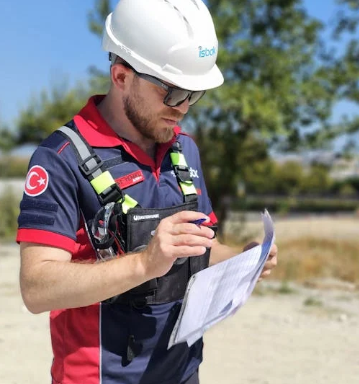
Site supervisor learning to identify construction activities onsite sanitation while reviewing scope of work document on a clipboard
Internal link: Before identifying activities, you must first learn to interpret onsite sanitation drawings.
PART ONE: WHAT IS A SCOPE OF WORK?
Before you can identify construction activities onsite sanitation, you must understand the document that defines them.
1.1 Definition
A Scope of Work (SoW) is a written description of all tasks, deliverables, and construction activities onsite sanitation required to complete a project. It is legally binding and part of the contract between client and contractor.
1.2 What a Good Scope of Work Includes
- A complete list of construction activities onsite sanitation
- Quantities (e.g., “excavate 15 cubic meters”)
- Materials specifications (e.g., “class 25 concrete”)
- Quality standards (e.g., “BS 8005 compliant”)
- Sequence or phasing
- Health, safety, and environmental requirements
1.3 Why the Scope of Work Matters
| Problem | Consequence |
| Activity not listed | Contractor claims extra cost → dispute |
| Activity listed but ignored | Incomplete facility → fails inspection |
| Wrong sequence | Rework, delays, cost overruns |
Golden rule: If a construction activity is in the scope, you must do it. If it is not, do not assume it is included.
For standard contract formats, refer to FIDIC construction contracts (external link).
PART TWO: ALL CONSTRUCTION ACTIVITIES ONSITE SANITATION
The range of construction activities onsite sanitation can be grouped into five categories. Each is explained below with practical examples.
2.1 How to Identify Construction Activities Onsite Sanitation: Surveying, Setting Out, Alignment, Gradient
These are the first construction activities onsite sanitation. You cannot dig before you know where and how deep.
Surveying
- What it is: Measuring the site to determine existing ground levels, slopes, and boundaries.
- Tools: Tape measure, level staff, dumpy level or laser level.
- Output: A site survey drawing or marked ground levels.
Setting Out
- What it is: Transferring the engineering drawing onto the ground using pegs, string lines, and spray paint.
- What you set out:
- Tank corners
- Pipe trench centerlines
- Inspection chamber positions
- Soak pit location
- Access route for desludging vehicles
Alignment and Gradient
- Alignment: Ensuring pipes and structures are positioned exactly as shown on the drawing.
- Gradient: Checking and maintaining the correct pipe slope.
- 100 mm pipe: 1:40 (2.5%)
- 150 mm pipe: 1:60 (1.67%)
After these construction activities onsite sanitation, the entire facility should be clearly marked on the ground.
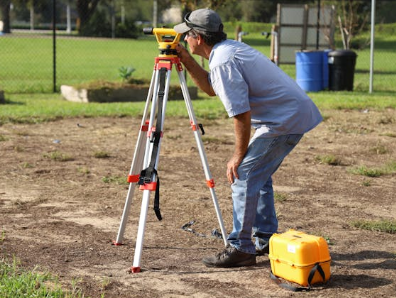
Surveyor performing setting out to identify construction activities onsite sanitation using laser level and wooden pegs
2.2 How to Identify Construction Activities Onsite Sanitation: Excavation, Timbering, Backfilling
Once the site is set out, physical construction activities onsite sanitation begin.
Excavation
- What it is: Removing soil to create space for the tank, soak pit, pipe trenches, and inspection chambers.
- Types:
- Open excavation for tanks (large area)
- Trench excavation for pipes (narrow and long)
- Soil considerations:
- Loose sand requires shoring
- Rock requires breaking (jackhammer)
- Wet soil requires dewatering
Timbering to Trenches (Shoring)
- What it is: Installing wooden or metal supports inside trenches to prevent collapse.
- When required:
- Trenches deeper than 1.5 meters
- Loose or sandy soil
- Areas with vibration (near roads or machinery)
- Safety note: A trench collapse can kill within minutes. Timbering saves lives.
Backfilling
- What it is: Replacing soil after pipes or structures are installed.
- Proper procedure:
- Bedding layer (sand or fine gravel) under the pipe
- Pipe laid and jointed
- Initial backfill around pipe — compacted
- Final backfill to ground level — compacted in layers
Common error: Backfilling without compacting leads to ground settlement and pipe damage.
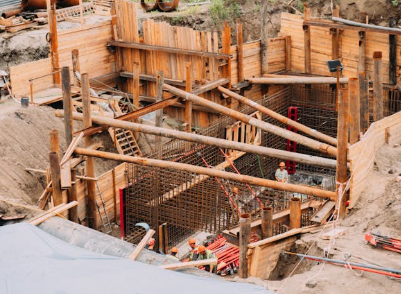
Timbering to trenches showing wooden supports as part of construction activities onsite sanitation for worker safety
2.3 How to Identify Construction Activities Onsite Sanitation: Concrete, Steel, Timber Works
Most construction activities onsite sanitation involve concrete and reinforcement.
Concrete Works
- What it is: Mixing, placing, and curing concrete for:
- Base slabs
- Tank walls
- Cover slabs
- Inspection chambers
- Soak pit rings
- Concrete mixes:
- Class 20 (20 MPa): General use
- Class 25 (25 MPa): Tank walls, base slabs
- Class 30 (30 MPa): Heavy-duty covers
- Curing: Keep concrete moist for at least 7 days. Failure to cure causes cracks.
Steel Works (Reinforcement)
- What it is: Cutting, bending, placing, and tying reinforcing bars.
- Activities:
- Reading bar bending schedule
- Cutting bars to length
- Bending bars
- Placing bars with correct cover (40–50 mm)
- Tying bars with wire
- Typical rebar sizes: Y10, Y12, Y16
Timber Works
- What it is: Using wood for:
- Formwork (shuttering) for concrete
- Timbering to trenches
- Temporary supports
- Formwork requirements: Strong, watertight, easy to remove.
Critical check: Never remove formwork too early. Walls need 3–7 days; slabs need 7–14 days.
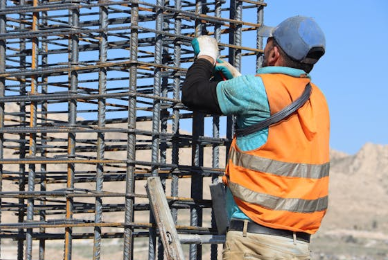
Steel reinforcement placement for concrete works as part of construction activities onsite sanitation showing Y12 bars at 200mm centers
2.4 How to Identify Construction Activities Onsite Sanitation: Laying and Jointing Pipes
Pipes are the arteries of any sanitation system. Incorrect laying or jointing ruins all other construction activities onsite sanitation.
Pipe Laying Steps
- Prepare trench bottom — level with correct gradient
- Lay bedding — 100–150 mm of sand or fine gravel
- Lower pipes carefully — do not drop
- Align pipes — straight line between inspection chambers
- Check gradient — using level or laser
Jointing Methods by Pipe Type
| Pipe Material | Jointing Method | Key Requirement |
| uPVC (soil pipe) | Solvent cement or rubber ring | Clean, dry surfaces |
| HDPE | Butt welding or electrofusion | Special equipment |
| Concrete pipe | Mortar or rubber ring | Heavy; large diameters |
Safety note: Solvent cement is flammable and toxic. Use in ventilated areas. Wear gloves.
For pipe jointing standards, refer to ISO 4435 for uPVC pipes .
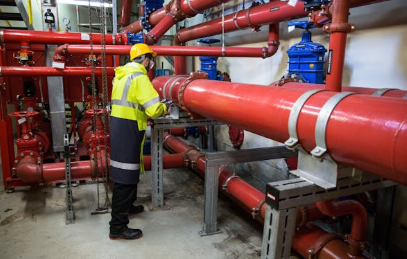
Worker performing pipe laying and jointing as part of construction activities onsite sanitation using solvent cement on uPVC pipe
2.5 How to Identify Construction Activities Onsite Sanitation: Roofing, Electrical, Plumbing, Finishes
Some construction activities onsite sanitation include shelters, pump houses, or treatment buildings.
Roofing
- Materials: Corrugated iron sheets, tiles, or concrete slab
- Activities: Roof structure, fixing sheets, gutters, vent pipe penetration
- Why it matters: Prevents rainwater from flooding the tank
Electrical Works
- Components: Lighting, pump control panels, high-level alarms, ventilation fans
- Requirement: Licensed electrician only. Water and electricity are deadly together.
- IP rating: Use IP65 or higher in wet areas
Plumbing Works
- What it is: Installing water supply pipes for flush toilets, handwashing stations, and cleaning
- Activities: Running pipes, installing taps and valves, pressure testing
Finishes
- Typical finishes:
- Plastering (walls of pump houses)
- Floor screeding (smooth, cleanable surfaces)
- Painting (waterproof paint for above-ground concrete)
- Tiling (public facilities for easy cleaning)
- Concrete apron around manholes (prevents surface water ingress)
- Screening or fencing (keeps children and animals away)
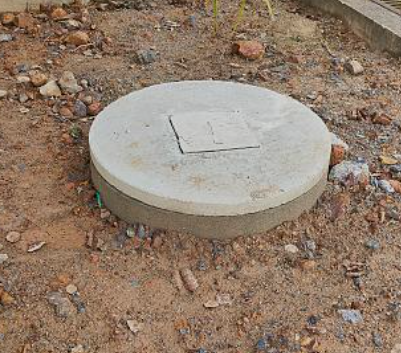
Completed concrete apron and manhole cover as finishing construction activities onsite sanitation
PART THREE: MAPPING ACTIVITIES TO SCOPE OF WORK AND DRAWINGS
The scope of work lists construction activities onsite sanitation. The drawings show how to do them. Your job is to connect the two.
3.1 How to Map
| Step | Action |
| 1 | Read the scope of work and underline every activity mentioned |
| 2 | Go through drawings and find where each activity is shown |
| 3 | Note if any activity in drawings is missing from scope (extra work — need variation order) |
| 4 | Note if any activity in scope is missing from drawings (incomplete design — ask engineer) |
| 5 | Create master activity list with drawing references |
3.2 Example Mapping Table
| Activity from Scope | Where Found in Drawings | Responsible Person |
| Survey and set out | Site layout plan (Drg No. 001) | Site surveyor |
| Excavate tank pit | Cross-section (Drg No. 003) | Excavator operator |
| Place base slab reinforcement | Structural drawing (Drg No. 005) | Steel fixer |
| Lay inlet pipe | Pipe network drawing (Drg No. 002) | Pipe layer |
| Backfill trench | Pipe network drawing (Drg No. 002) | Labourer |
PART FOUR: SEQUENCING CONSTRUCTION ACTIVITIES CORRECTLY
Identifying construction activities onsite sanitation is not enough. You must also know the correct order.
4.1 Typical Sequence
- Surveying and setting out
- Excavation (tank pit, pipe trenches, soak pit)
- Timbering (if required)
- Base slab concrete and reinforcement
- Curing (waiting period)
- Wall construction
- Pipe laying and jointing
- Backfilling (after pipe inspection)
- Cover slab concrete and reinforcement
- Finishes (plaster, apron, painting)
- Roofing
- Plumbing
- Electrical
- Cleaning and handover
- Training (operation and maintenance)
4.2 What Cannot Be Rushed
- Concrete curing – Minimum 7 days before loading
- Pipe joint curing – Solvent cement needs hours; mortar needs days
- Backfill compaction – Each layer must be compacted
PART FIVE: LEARNING OUTCOME CHECK
After learning to identify construction activities onsite sanitation, you should be able to:
| # | Learning Outcome |
| I | Read a scope of work and list every required activity |
| II | Distinguish between surveying, setting out, alignment, and gradient |
| III | Explain when timbering (shoring) is required and why |
| IV | Describe proper pipe laying and jointing steps |
| V | Map activities from scope of work to specific drawings |
| VI | Sequence construction activities onsite sanitation correctly |
| VII | Identify missing activities before construction starts |
CONCLUSION
Mastering the ability to identify construction activities onsite sanitation separates professional contractors from amateurs.
The amateur looks at the scope, says “I know how to build a septic tank,” and starts digging.
The professional reads the scope carefully, maps every activity to the drawings, sequences them logically, checks for missing items, and only then mobilizes to site.
The scope of work is your roadmap. The drawings are your detailed instructions. Together, they define all construction activities onsite sanitation that will lead to success.