
Construction scaffolds are temporary elevated platforms that support workers and materials during building, maintenance, and repair work. This guide explains the types, uses, and materials of construction scaffolds, helping building technicians select the right system for each task.
Introduction: What Are Construction Scaffolds?
Construction scaffolds are temporary structures that provide safe access to heights and areas that would otherwise be difficult to reach . Moreover, they support both workers and materials during construction, maintenance, and repair operations.
In addition, scaffolds fall into two basic categories. Supported scaffolds rest on rigid, load-bearing members such as poles, legs, or frames. Suspended scaffolds, on the other hand, hang from ropes or other non-rigid overhead supports .
Therefore, understanding these categories helps technicians choose the right system. Furthermore, the type of scaffold affects safety, cost, and speed of erection.
Why Construction Scaffolds Matter
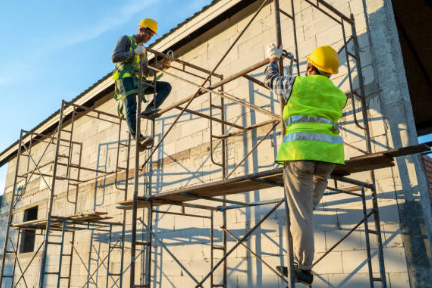
Scaffolds provide safe access at height. Without them, workers cannot reach upper floors, facades, or ceilings safely. Consequently, scaffolds prevent falls, which remain one of the leading causes of construction fatalities.
Moreover, scaffolds support materials and tools at the work face. As a result, workers avoid climbing with heavy loads. In addition, scaffolds allow multiple trades to work simultaneously on different levels.
Furthermore, scaffolds must carry loads safely. Therefore, every scaffold needs proper design, erection, and inspection before use.
Main Types of Construction Scaffolds
Scaffolds come in many types, each suited to particular applications. The main types are described below.
1. Frame Scaffolds (Tubular Frame Scaffolds)
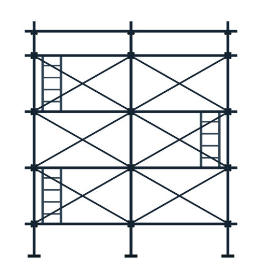
Frame scaffolds are the most widely used type. They consist of prefabricated frames connected by cross-bracing, with platforms resting on the frames .
Frame scaffolds are popular because of their simple design, speed of erection, component availability, and ease of use . They range from light duty to extra heavy duty depending on the size and spacing of components.
Moreover, frame scaffolds suit straight run areas where the ground is relatively level and unobstructed .
2. Tube and Clamp Scaffolds (Tube and Coupler)
Tube and clamp scaffolds consist of steel or aluminium tubes connected by rigid clamps. Workers use swivel clamps for diagonal members .
These scaffolds are infinitely adjustable in height and width. Consequently, they suit obstructions, non-rectangular structures, and circular or dome-shaped configurations .
However, tube and clamp scaffolds take longer to erect than frame scaffolds. In addition, personnel erecting them must be experienced, and scaffolds above 10 metres must be designed by a professional engineer .
3. System Scaffolds
System scaffolds are modular systems with patented locking devices. They are popular in applications traditionally suited to tube and clamp scaffolds .
Moreover, system scaffolds suit non-rectangular, circular, or dome-shaped structures. They range from light-duty aluminium to heavy-duty steel support structures .
System scaffolds above 10 metres must also be designed by a professional engineer .
4. Tower Scaffolds
Tower scaffolds are independent, freestanding structures. They are one way to prevent falls when working at height .
However, towers can overturn if erected incorrectly. Therefore, they must rest on firm, level ground with locked castors or base plates properly supported. Moreover, stabilisers or outriggers must be installed when required .
Towers should never exceed the height recommended by the manufacturer .
5. Suspended Scaffolds
Suspended scaffolds hang from overhead structures using ropes or other non-rigid supports . Common types include:
- Two-point (swing stage) – platform supported by two ropes
- Multi-point adjustable – platform suspended by more than two ropes
- Single-point adjustable – platform suspended by one rope
- Catenary – platform supported by two horizontal parallel ropes
Suspended scaffolds suit exterior facade work, window cleaning, and bridge maintenance.
6. Mobile Rolling Scaffolds
Mobile rolling scaffolds are portable scaffolds mounted on castors or wheels . Consequently, workers can move them easily across level surfaces.
However, mobile scaffolds must have lockable wheels. In addition, workers must never move them while people or materials remain on the platform .
7. Specialty Scaffolds
Specialty scaffolds serve narrow, specific applications. These include:
- Horse scaffolds – platform supported by construction horses (sawhorses)
- Ladder jack scaffolds – platform resting on brackets attached to ladders
- Pump-jack scaffolds – platform supported by vertical poles with movable brackets
- Outrigger scaffolds – brackets attached to a building or structural walls
Each specialty scaffold has specific requirements under OSHA standards .
Uses of Construction Scaffolds
Scaffolds serve many construction tasks. The table below summarises the main applications.
| Task | Recommended Scaffold Type |
| Straight run facade work | Frame scaffolds |
| Circular or irregular structures | Tube and clamp or system scaffolds |
| Interior work at height | Tower scaffolds or mobile scaffolds |
| Exterior facade maintenance | Suspended scaffolds |
| Light tasks (painting, electrical) | Light-duty scaffolds |
| Heavy masonry and cladding | Heavy-duty scaffolds |
| Spanning openings | Frame scaffolds with putlogs or system scaffolds with trusses |
| Stair towers | Frame or system stair towers |
Materials Used in Construction Scaffolds
Scaffold materials must balance strength, weight, and durability. The main materials are described below.
1. Steel
Steel is the most common scaffold material. It offers high strength, durability, and dimensional accuracy. Moreover, steel scaffolds suit heavy-duty applications and long-term projects.
However, steel is heavy, which increases transport and erection costs. In addition, steel requires protection against corrosion .
2. Aluminium
Aluminium scaffolds are lightweight yet strong. Consequently, workers can handle them manually, which speeds up erection .
Moreover, aluminium resists corrosion. Therefore, it suits mobile towers and applications where weight matters. However, aluminium costs more than steel and may deflect under heavy loads.
3. Timber
Timber was the first material used for scaffolding . Today, timber scaffolds serve specific applications, particularly in masonry work.
Scaffold-grade lumber must meet strict grading rules. It must have at least six rings per inch, limited grain slope, and few defects . Moreover, construction-grade lumber has only two-thirds the capacity of scaffold-grade lumber, so it must never substitute for it .
4. Plywood and Wood-Based Materials
Plywood and wood-based materials serve as platform decks and formwork surfaces. Moreover, plywood for scaffold decks has specific requirements under European standards .
5. Cast Iron
Cast iron appears in some older scaffold fittings and couplers. However, modern scaffolds rarely use it .
Scaffold Platform Materials
Platforms are arguably the most critical scaffold component. In fact, more scaffold incidents involve planking giving way than any other cause .
Wood Planks
Wood planks must be scaffold-grade, identified by a grade stamp from a recognised lumber grading association .
Planks with splits more than a few inches long must be removed from service. Moreover, planks with checks (surface cracks) should be watched, as they may develop into splits .
Planks that have accumulated layers of paint or plaster must not remain in service, because dangerous splits may hide underneath .
Fabricated Planks
Fabricated planks and platforms use manufacturer-rated load capacities. These ratings include light-duty (25 lbs/ft²), medium-duty (50 lbs/ft²), and heavy-duty (75 lbs/ft²) .
Scaffold Duty Ratings
Scaffolds carry specific duty ratings that determine their maximum load. Therefore, technicians must match the scaffold rating to the task.
| Duty Rating | Maximum Live Load | Typical Uses |
| Light duty | Up to 225 kg per bay | Painting, electrical, carpentry |
| Medium duty | Up to 450 kg per bay | Tiling, light steel framing |
| Heavy duty | Up to 675 kg per bay | Block laying, bricklaying, concreting |
| Special duty | As designed | Loading bays |
Always confirm the duty rating before loading a scaffold .
Safety Requirements for Construction Scaffolds
Scaffold safety depends on proper design, erection, and inspection. Therefore, technicians must follow these requirements.
Design and Erection
Scaffolds must be designed by a qualified person and constructed according to that design . Moreover, scaffolds must be erected, altered, and dismantled only by competent people under competent supervision .
Inspection
Scaffolds from which a person might fall 2 metres or more must be inspected on completion and at least weekly thereafter. Inspection is also required after bad weather and after any modification .
Fall Protection
Guard rails, toe boards, and other barriers must protect workers from falls. Top guard rails must stand at least 950 mm above any edge. Toe boards must prevent materials from rolling off. Intermediate guard rails must keep unprotected gaps below 470 mm .
Access
Safe access to platforms is essential. Ladders or stair towers must provide proper access. Workers must never climb cross-bracing as a means of access .
Loading
Scaffolds are not usually designed to support heavy loads on their working platforms. Therefore, inform the scaffold provider if you intend to load out platforms .
Common Scaffold Hazards
Scaffold work involves several hazards. Therefore, technicians must recognise and control them.
- Falls – due to lack of fall protection
- Collapse – caused by instability or overloading
- Struck-by – from falling tools, materials, or debris
- Electrocution – due to proximity to overhead power lines
- Instability – from poor foundation or missing bracing
- Access hazards – from inadequate ladders or stairs
Common Mistakes to Avoid
Many scaffold failures result from avoidable errors. Therefore, avoid the following common mistakes.
- Using construction-grade lumber instead of scaffold-grade lumber
- Erecting towers above the manufacturer’s recommended height
- Moving mobile scaffolds with workers or materials on them
- Ignoring wind loading on sheeted scaffolds
- Failing to inspect scaffolds after modification
- Using incompatible components from different systems
- Overloading platforms beyond their duty rating
- Neglecting to provide safe access to platforms
Conclusion
Construction scaffolds provide essential access at height for building, maintenance, and repair work. When technicians select the right type, use the correct materials, and follow safety requirements, scaffolds protect workers and improve productivity.
Moreover, scaffold safety depends on proper design, competent erection, and regular inspection. Therefore, never cut corners. As a result, construction proceeds safely, and workers return home unharmed.
Frequently Asked Questions
What are the main types of construction scaffolds?
The main types are frame scaffolds, tube and clamp scaffolds, system scaffolds, tower scaffolds, suspended scaffolds, mobile rolling scaffolds, and specialty scaffolds.
What materials are used for scaffolds?
Scaffolds use steel, aluminium, timber, and plywood. Steel and aluminium dominate modern scaffolds, while timber serves specific masonry applications.
What is scaffold-grade lumber?
Scaffold-grade lumber is wood that meets strict grading rules for strength. It has at least six rings per inch and limited defects. Construction-grade lumber has only two-thirds the capacity and must not substitute for it .
How often must scaffolds be inspected?
Scaffolds from which a person might fall 2 metres or more must be inspected on completion and at least weekly thereafter. Inspection is also required after bad weather and modifications .
What is a scaffold duty rating?
A duty rating defines the maximum load a scaffold platform can carry. Ratings include light duty (225 kg per bay), medium duty (450 kg per bay), and heavy duty (675 kg per bay)