
In the field of environmental and civil engineering, the accurate measurement of pressure, velocity, and discharge is fundamental to the design, operation, and management of water and wastewater infrastructure systems. The selection of appropriate measurement tools and equipment is not arbitrary but is systematically determined by the physical and chemical properties of the fluid being measured. This academic blog explores the relationship between fluid properties and measurement instrumentation, providing engineers and researchers with a comprehensive framework for equipment selection based on established fluid mechanics principles.
1. Introduction
Fluid mechanics serves as the cornerstone of hydraulic engineering, encompassing the study of fluids at rest and in motion . The measurement of key hydraulic parameters pressure, velocity, and discharge requires careful consideration of the fluid’s characteristics, as these properties directly influence instrument performance, accuracy, and reliability . As noted in the literature, “the first step is always a thorough analysis of your application’s requirements,” with fluid properties being the primary consideration .
The fundamental relationship governing fluid flow measurement is rooted in the continuity equation and Bernoulli’s principle, which establish the interconnection between pressure, velocity, and flow rate . These principles underpin the operation of most flow measurement devices, from simple obstruction meters to sophisticated electronic instruments .
2. Fluid Properties Influencing Instrument Selection
2.1 Density and Specific Weight
Density (ρ) and specific weight (γ) are fundamental fluid properties that affect measurement instruments in several ways. Differential pressure flow meters, for instance, rely on the relationship where pressure drop is a function of the square of flow velocity multiplied by fluid density :
text
dp = ρ v² / 2
This relationship means that for the same velocity, denser fluids produce higher pressure differentials, affecting the sensitivity and range of differential pressure instruments .
2.2 Viscosity
Viscosity, representing a fluid’s resistance to flow, is a critical parameter in instrument selection . High-viscosity fluids such as oils, syrups, and food products require different measurement technologies than low-viscosity fluids like water . As documented in flow meter selection guides, viscosity is “required for liquids” when specifying appropriate instrumentation .
Mechanical flow meters, particularly positive displacement types, demonstrate exceptional accuracy for high-viscosity fluids . The oval gear flow meter, a type of positive displacement meter, is recommended for “measuring viscous liquids like oils, fuels, chemicals, solvents, and syrups” . Conversely, vortex flow meters perform poorly with high-viscosity fluids .
2.3 Electrical Conductivity
Electrical conductivity is a determining factor for electromagnetic flow meters, which operate on Faraday’s law of electromagnetic induction . These instruments require electrically conductive fluids, with a minimum conductivity threshold of approximately 5 µS/cm for externally powered devices and 50 µS/cm for loop-powered variants .
As documented in the literature, electromagnetic flow meters are suitable for “water, wastewater, sludge, slurries, pastes, acids, alkalis, juices, fruit pulp” but cannot measure “nonconductive liquids” such as fuel oils, organic solvents, liquid sugar, and demineralised water .
2.4 Temperature and Pressure
Operating temperature and pressure significantly influence instrument selection. Some fluids may solidify at relatively high temperatures, requiring heated flow meters, while condensation may be problematic for chilled products, necessitating remote housing for electronics . The ability of instruments to withstand high temperatures is a key specification documented in selection matrices .
2.5 Fluid Composition and Solids Content
The presence of suspended solids, slurries, or gas bubbles influences instrument selection significantly. For fluids containing entrained solids, “non-obstructive measurement” is often required to prevent fouling or damage . Magnetic flow meters are particularly suitable for slurries, while positive displacement meters are unsuitable due to the risk of jamming from suspended solids .
3. Pressure Measurement Instruments
3.1 Manometers
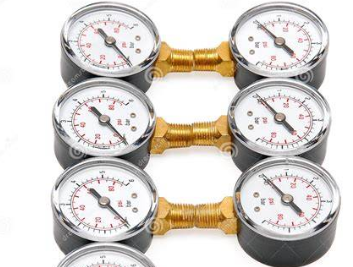
Manometers represent the most fundamental pressure measurement devices, operating on the principle of hydrostatic equilibrium. As documented in course materials, pressure measurement devices include “piezometer, manometer, differential manometer and bourdon gauge” . Manometers are particularly useful for measuring small pressure differentials in laboratory settings and field applications.
3.2 Bourdon Gauges
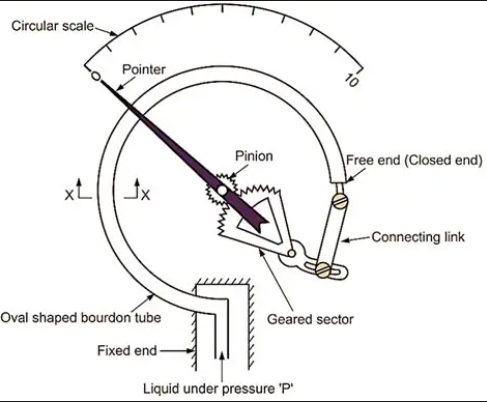
The Bourdon gauge is a widely used mechanical pressure measurement device, translating pressure-induced deformation of a curved tube into a dial reading . These instruments are robust, require no external power, and are suitable for a wide range of pressures and fluid types.
3.3 Differential Pressure Sensors
Modern differential pressure sensors utilise electronic transducers to measure pressure differences across obstructions in flow paths. These sensors are essential components of differential pressure flow meters, providing the pressure differential signal used to calculate flow rate .
4. Velocity Measurement Instruments
4.1 Pitot Tubes
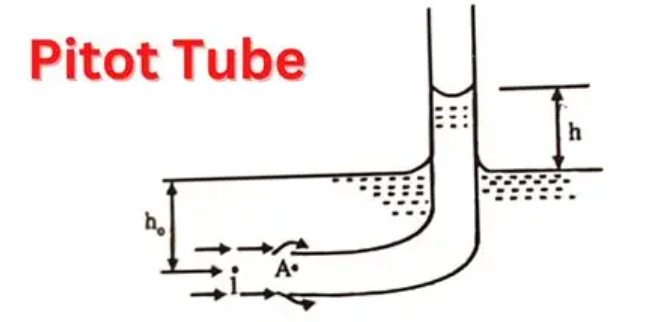
The Pitot tube remains one of the most widely used and cost-effective methods for measuring fluid flow velocity, “especially in air applications like ventilation and HVAC systems, even used in airplanes for speed measurement” . The principle involves converting the kinetic energy of flow into potential energy, allowing velocity determination from pressure measurements .
However, the use of Pitot tubes is “restricted to point measuring,” meaning they measure velocity at a single point in the flow cross-section . Advanced variants like the “annubar” or multi-orifice pitot probe overcome this limitation by measuring dynamic pressure across the velocity profile, providing averaging effects .
4.2 Acoustic Doppler Velocity Meters
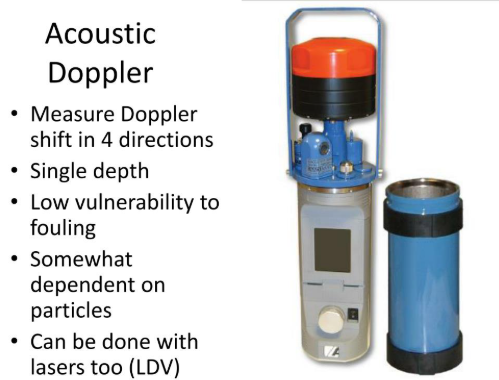
Acoustic Doppler Velocity Meters (ADVM) and Acoustic Doppler Velocimeters (ADV) represent advanced velocity measurement technologies. These instruments “compute water velocities using the Doppler shift of sound transmitted underwater and reflected off moving particulates suspended in the water” . The distinguishing feature of ADV versus ADVM is that ADV “measures velocities in a small volume thus may be considered a point meter while an ADVM measures velocities in one or more larger sample volumes” .
These instruments are self-calibrating but “calibration by discharge measurements would likely be needed” for optimal accuracy . The main consideration is “to avoid contamination of the acoustic signal by physical boundaries, namely, the walls of the conduit” .
4.3 Laser Doppler Velocimetry
Laser beams have been “used for studying the turbulent characteristics of flowing liquids and for determining the velocity of fluid flow” . The Doppler principle involves “a measurable shift in the frequency of the light” . While primarily a research tool, laser-based velocimetry provides non-intrusive, high-resolution velocity measurements suitable for complex flow studies.
5. Discharge Measurement Instruments
5.1 Differential Pressure Flow Meters
Differential pressure flow meters represent the most common category of flow measurement instruments, accounting for approximately 50% of instruments in industrial use . These devices measure flow by creating an obstruction in the flow path and measuring the resulting pressure drop, which is proportional to the square of flow velocity .
5.1.1 Orifice Plate
The orifice plate is the simplest and most economical differential pressure device. The plate “obstructing the flow offers a precisely measured obstruction that narrows the pipe and forces the flowing fluid to constrict” . The relationship of rate of flow to head and dimensions is defined by the equation :
text
Q = (C A₂ √(2 g h)) / √(1 – r⁴)
where C is the coefficient of discharge, A₂ is the throat area, h is the pressure head differential, and r is the diameter ratio.
Orifice plates are “simple, cheap and can be delivered for almost any application and in any material” . However, their “Turn Down Ratio” is less than 5:1, accuracy is poor at low flow rates, and wear reduces accuracy over time .
5.1.2 Venturi Meter
The Venturi meter offers higher accuracy and lower head loss than orifice plates . These meters operate on the principle “that flow in a given closed-conduit system moves more rapidly through areas of small cross-section than through areas of large cross-section” . The pressure decrease in the constricted throat is “directly related to the rate of flow passing through the meter” .
Venturi meters are “highly accurate and efficient flow meters” with “no moving parts, require little maintenance and cause little head loss” . The coefficient of discharge ranges from approximately 0.935 for small throat velocities to 0.988 for relatively large throat velocities .
5.1.3 Flow Nozzle
The flow nozzle represents a simplified variant of the Venturi meter, “a venturi meter that has been simplified and shortened by omitting the long diffuser on the outlet side” . While the streamlined entrance provides a straight cylindrical jet without contraction, the high degree of turbulence downstream causes “a greater loss of head than occurs in the venturi meter” .
5.2 Electromagnetic Flow Meters
Electromagnetic flow meters operate on Faraday’s law of electromagnetic induction, where a “voltage will be induced when a conductor moves through a magnetic field” . The liquid serves as the conductor, and the magnetic field is created by energized coils outside the flow tube. The induced voltage is “proportional to the flow rate and independent of changes in fluid density, viscosity and pressure” .
These instruments are suitable for “electrically conductive liquids (> 5 µS/cm) with or without solids, e.g. water, wastewater, sludge, slurries, pastes, acids, alkalis, juices, fruit pulp” . They feature “no moving parts, no obstruction to flow (no pressure drop), excellent accuracy, and highly reliable for a wide range of applications” . However, they are not suitable for nonconductive liquids like oils and hydrocarbons .
5.3 Ultrasonic Flow Meters
Ultrasonic flow meters measure flow velocity using sound waves, employing either transit-time (time-of-flight) or Doppler methods . The transit-time method measures “the difference in the time of propagation between a pulse travelling with and against the flow” . The Doppler method measures “the change in frequency that occurs when an ultrasonic pulse is reflected by a bubble or particle” .
These instruments offer significant advantages: “can be non-invasive (clamp-on models), causing no pressure drop or process interruption” and “can be used on very large pipes” . However, they have “higher initial cost” and “accuracy can be affected by the fluid’s acoustic properties, solids, or gas bubbles” .
5.4 Vortex Flow Meters
Vortex flow meters measure flow velocity by “counting the number of vortices shed per second from a bluff body” . An obstruction in a fluid flow creates vortices in the downstream flow, and the frequency of vortex shedding is proportional to flow velocity . These meters are “cost-effective in providing instantaneous flow rate and totalised flow” with “no moving parts” .
They are versatile, measuring “liquids, gases and steam” and are “very durable” . However, they “create a small pressure drop” and “require a minimum flow rate to generate vortices” .
5.5 Coriolis Flow Meters
Coriolis mass flow meters use “the frequency shift caused by a flow of liquid through two metering tubes oscillating at their natural frequency” to measure mass flow directly . Since the natural frequency is related to the mass of fluid in the tubes, density is also measured, and tube temperature is monitored for compensation .
These instruments offer “high accuracy” and measure “virtually all fluids: cleaning agents and solvents, fuels, vegetable oils, animal fats, alcohol, fruit solutions, vinegar, ketchup, mayonnaise, gases, etc.” . They are particularly suitable for “viscous media and compound products such as soup, chocolate, honey and mayonnaise” . There is no requirement for upstream and downstream straight pipe lengths .
6. Flow Measurement in Open Channels
Open channel flow occurs “when the flowing stream has a free or unconstrained surface open to the atmosphere,” such as canals and ventilated pipelines not flowing full . The force causing flow is gravity, and water surface elevation decreases progressively downstream .
6.1 Weirs and Notches
Weirs and notches are commonly used for open channel flow measurement, with the flow rate determined based on head over the crest . Rectangular weirs, V-notch weirs, and Parshall flumes are specified in flow measurement calculations .
6.2 Current Meters
Current meters are used to measure velocity in open channels by determining the rate of rotation of a propeller or rotor . These instruments are commonly employed in streams and rivers for flow measurement.
7. Instrument Selection Framework
7.1 Systematic Selection Process
The selection of appropriate measurement instruments follows a systematic process :
- Confirm the properties of the detection fluid – fluid type, density, viscosity, electrical conductivity, contaminants, flow range, temperature, pressure, and pressure loss requirements
- Clarify the purpose of measurement – determine selectable detection systems with associated accuracy and flow range
- Confirm product specifications – detailed model specifications
- Consider cost – including unit price, maintenance time, and setup or troubleshooting costs
7.2 Fluid-Specific Recommendations
| Fluid Property | Recommended Instrument Types | Not Recommended |
| Conductive liquids (water, wastewater) | Electromagnetic, Ultrasonic | — |
| Non-conductive liquids (oils, hydrocarbons) | Oval gear, Turbine, Coriolis | Electromagnetic |
| High-viscosity liquids | Positive displacement, Coriolis | Vortex, Orifice plate |
| Slurries and solids-laden fluids | Electromagnetic, Ultrasonic Doppler | Positive displacement, Turbine |
| Gases and steam | Differential pressure, Thermal mass, Vortex | Electromagnetic |
| Clean, low-viscosity liquids | Turbine, Ultrasonic, Vortex | Positive displacement (overkill) |
The following general recommendations can be made based on fluid properties :
8. Conclusion
The identification of tools and equipment for measuring pressure, velocity, and discharge is fundamentally based on fluid properties. The relationship between fluid characteristics and instrumentation selection is governed by physical principles—density affects pressure drop calculations, viscosity influences mechanical meter performance, and electrical conductivity determines the applicability of electromagnetic instruments.
Engineers must systematically evaluate fluid properties, operating conditions, performance requirements, and economic factors when selecting measurement instruments. The framework presented in this blog provides a structured approach to this decision-making process, ensuring that measurement systems provide accurate, reliable data essential for the design and operation of water and wastewater infrastructure.
As flow measurement technology continues to evolve, with trends toward ultrasonic and Coriolis meters and away from rotating devices , the fundamental principle remains constant: the right tool for the job depends on understanding the fluid being measured.