
Learning Outcome
1.1 Identify properties of fluids
1.2 Identify tools and equipment for measurement of
pressure, velocity, and discharge
1.3 Apply hydraulic principles
Apply Hydraulic Engineering Principles
Introduction to learning outcome
This learning outcome covers fluid properties, fluid pressure measurement, discharge and
velocity measurement, head losses in pipes, and simple channel sections.
Definition of key terms
Pascal’s law- A pressure change at any point in a confined incompressible liquid is
transmitted throughout the fluid such that the same change occurs everywhere.
Area of the flow-The region through which a fluid flows
Rate of flow-the the volume of fluid that flows per unit time.
1.1 Identify properties of fluids (Density, Surface Tension, Viscosity, Specific Weight,
Specific Gravity, Compressibility, Capillarity, Specific Mass) based on standards
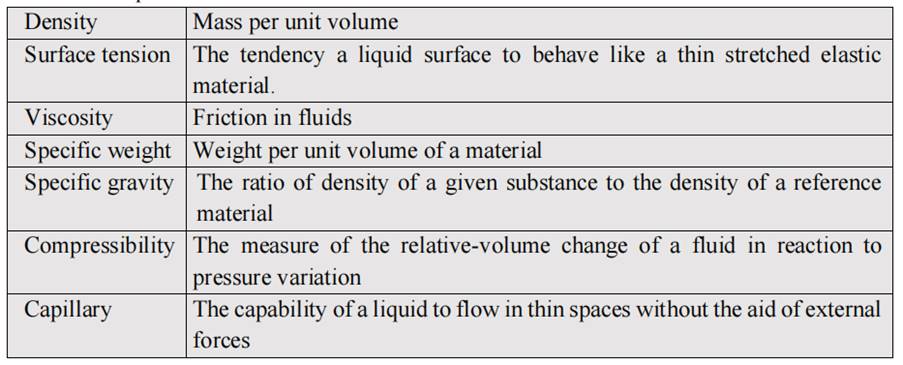
Table 1: Properties of fluids
1.2 Identify tools and equipment for measurement of pressure, velocity, and
discharge based on fluid properties
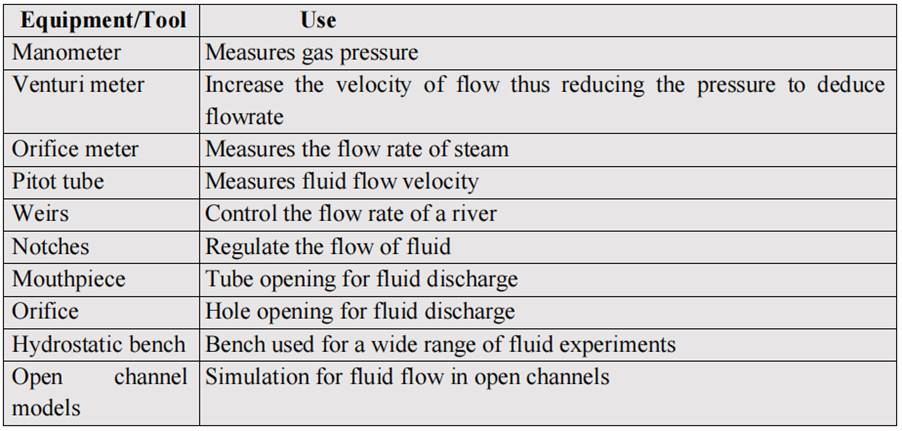
Tools and equipment
Apply hydraulic principles based on the types of fluids
Hydraulic principles is an application of Pascal’s law.
Types of fluids include;
Pascal’s principle applies to ideal fluids due to their incompressibility and lack of viscosity.
principles
Hydraulic principles apply to viscous, real fluids.
3. Newtonian fluid-Refers to a real fluid that conforms to newton’s law of viscosity717
4. Non-Newtonian fluid- A real fluid that does not obey the newtons law of viscosity
5. Ideal plastic fluid-shear stress is proportional to its shear strain
Conclusion
This learning outcome covered fluid properties, fluid pressure measurement, discharge and
velocity measurement, head losses in pipes, and simple channel sections.
Written Assessment
1. Select the odd one out in the fluid types listed.
a) Ideal
b) Real
c) Newtonian
d) Elastic
2. Which equipment measures gas pressures?
a) Venturi meter
b) Manometer
c) Orifice
d) Weir
3. The ratio of the mass of a fluid to its volume is called
a) Capillary
b) Specific mass
c) Specific gravity
d) Specific weight
4. Which one is not a variable considered in fluid mechanics.
a) Pascal’s pressure law
b) rate of flow
c) Area of flow
d) Couple coplanar forces
5. Derive Pascal’s law from first principles.
6. Summarize the types of fluids 718
7. Evaluate the following functions.
a) Weir
b) notch
c) mouthpiece
d) orifice
e) venture meter
f) manometer
8. Distinguish between specific weight and specific gravity
9. Explain the properties of a real fluid
10. Highlight the applications of surface tension in real life
11. Differentiate between a notch and a weir
12. Discuss the benefits of understanding fluid mechanics to an engineer.
13. There exist no ideal fluids. Discuss
Oral Assessment
1. Based on the pressure law experiment.
2. What are the observations made from the experiment?
3. What conclusion can be made based on the above observations?
Practical Assessment
Design an experiment demonstrating Pascal’s law.